
What Is Somatic Therapy? A Plain-Language Guide


It is 11.40pm. The lights are off and the aircon hums. You have already explained the situation to yourself, reasonably and thoroughly: the deadline is manageable and there is nothing to solve tonight. Your mind is persuaded. Your jaw is not. Your chest holds its small brace and sleep stays just out of reach, the way it has for months.
Somatic therapy is psychotherapy that treats the body as a full participant in the work. Alongside the story you tell, it works with the state your nervous system is holding. That gap, between what you understand and what your body keeps doing, is exactly where it earns its place.
So let me explain what is happening in a nervous system that will not back down, how Somatic Experiencing, one of the best-known methods in this family, actually works and where body-based work complements CBT and EMDR. While there is no best approach for everyone, what matters more is having the curiosity to find an approach or a therapist that we feel most safe and attuned to.
Why insight does not reach the body
Somatic simply means of the body, from the Greek soma. Stress and trauma are not filed away as tidy stories. They are held as states: a readiness to flinch, a habit of bracing, a numbness that arrives when things get close. The parts of the brain that keep those states running do not speak in paragraphs, which is why a purely verbal approach sometimes stalls. You can gain insight after insight, genuinely accurate insight, and the body keeps responding to a danger that ended years ago.
You cannot reason a nervous system into safety. You can only show it.
Talk still matters; this is talk therapy, not massage. What changes is where the attention goes. Alongside the story, we track what the story does in your body as you tell it because that is where the unfinished business announces itself.
The window of tolerance and the two ways out
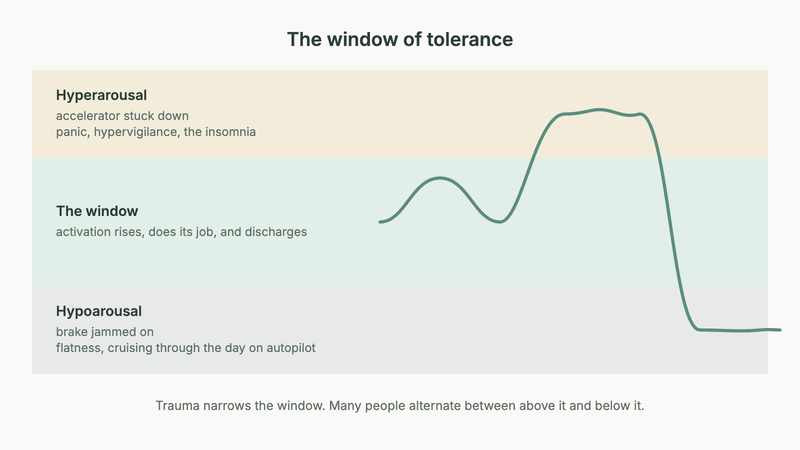
A useful plain-language map: your autonomic nervous system has an accelerator and a brake. Under threat it accelerates you into fight or flight, or, when neither is possible, slams the brake into shutdown. In a healthy rhythm, activation rises, does its job, and discharges; the system returns to baseline.
Psychiatrist Dan Siegel gave that middle range a name in 1999 and it has been standard vocabulary in trauma work ever since: the window of tolerance. Inside it you can feel a great deal and still think clearly and stay in contact with the person in front of you. Calm is not the entry requirement; the window is simply the range where feeling and thinking still work together.
Trauma and chronic stress narrow that window and you can only leave it in one of two directions. Above it is hyperarousal, the accelerator stuck down: panic, irritability, hypervigilance, the insomnia. Below it is hypoarousal, the brake jammed on: flatness, numbness, fatigue, and cruising through the day on autopilot. Many people alternate between both and conclude that something is wrong with them. Nothing is wrong with the person but rather it is our protective system that stays activated and never gets discharged.
I have written before about what the shutdown end feels like from the inside, in The Autopilot Commute, and about the practical skill of coming back, in How to Ground Yourself.
Somatic Experiencing: completing what the body started
Somatic Experiencing, or SE, is the method most people mean when they say somatic therapy. It was developed by Peter Levine, whose book Waking the Tiger begins with an observation from the animal world: prey animals live under constant threat, yet rarely end up traumatised. When the chase ends, the body visibly discharges the survival energy it mobilised, trembling, shaking, breathing it through, and then returns to grazing. Humans have the same completion mechanisms and we routinely override them. We hold it together. We stay professional. We tell ourselves it was fine. And many of us were raised where composure was praised and strong feelings were quietly called drama, so the holding started young. The energy that was mobilised to survive stays bound in the system and Levine's argument is that this bound, incomplete response, not the event itself, is what we experience as trauma.
SE works by helping the body finish what it started, in doses small enough to stay safe. Rather than retelling the worst of the story, we work with the felt sense, the body's moment-to-moment experience of sensation. We touch the edge of the activation briefly, then return to steadiness, and let the system swing gently between the two. SE calls this titration and pendulation; I describe it to clients as small sips, never floods. Done well, something quietly physiological happens: a wave of heat, a tremble, a long breath the body takes by itself. That is a stress response completing, sometimes decades late. SE calls the wider process renegotiation because the point is not to relive the experience but to give it a different ending in the body.
On evidence: body-based approaches are younger than CBT in research terms and it is fair to say the evidence base is growing rather than settled. The first randomised controlled study of SE, published in the Journal of Traumatic Stress in 2017, found meaningful reductions in post-traumatic symptoms and depression. Somatic Experiencing International keeps an open research library for anyone who wants to read further. I am currently completing the professional training in SE, which sits alongside my completed certifications in other body-based methods within trauma-informed psychotherapy.
If posts like this are useful to you, you can subscribe at the bottom of the page to be notified when new posts are up.
What a session looks like from the inside
Mostly, it looks like two people talking. The difference is the pauses. As you speak, I will sometimes invite you to notice what is happening below the neck: where the story tightens something, where the breath changes, where an unexpected settling arrives. We slow down around those moments instead of driving past them. A simple version of this is something you can try tonight: stop, look slowly around the room and let your eyes rest on what they find, then notice your fingers, then your toes. That small ritual tells the oldest parts of your brain what no argument can: you are here and here is safe enough.
Two reassurances, because people carry quiet worries into this work. First, you do not have to narrate your trauma in detail for the work to move; the body's present-tense responses give us plenty to work with. Second, touch is not required for somatic therapy to work. Most of the work is conversational. If a touch-based intervention would ever be helpful, it happens only with your clear consent, discussed openly beforehand, and declining changes nothing.
Somatic work next to CBT and EMDR
Placing the approaches side by side makes the choice less mysterious; the complete comparison, including TRE and DBT, is in Types of Trauma Therapy, Explained.
CBT works from the top down. It helps you catch the thought behind the feeling, examine it, and test new responses, with structure and practice between sessions. It has the deepest evidence base in the field and for many people it is the right first choice. Somatic therapy works from the bottom up: it starts with the state the body is in, on the logic that a system stuck in survival cannot think its way out because thinking is precisely what survival states switch off.
EMDR sits somewhere between. Developed by psychologist Francine Shapiro, it works directly with how distressing memories are stored, using guided eye movements while the memory is briefly held in mind. The World Health Organization's 2013 guidelines name trauma-focused CBT and EMDR as the recommended psychotherapies for post-traumatic stress, which reflects how well studied both are. EMDR is more protocol-shaped than SE and involves less narrating than classic exposure work.
And because human beings are not only bodies, body-based work pairs naturally with parts work. The tight chest usually belongs to someone in there: a part that learned to brace early and never got told the danger passed. That is the territory of Internal Family Systems, which I have written about in a companion post, What Is IFS?, and it is the other core lens of how I work.
There is no best therapy, there is fit
If you take one thing from this post, let it be this: the honest answer to "which therapy is best" is always "for whom, for what, and when". A model is a map and no map is the territory. Someone in acute crisis needs stabilising skills before any depth work. Someone who intellectualises beautifully may need the body first, precisely because words are where they hide. Someone flooded by sensation may need structure and thought before the body feels safe to visit. Good therapy is not loyalty to a method. It is the discipline of matching the approach to the person and their circumstances, then adjusting as the season changes.
That matching conversation is, genuinely, what a first call is for.
You are allowed to stop explaining yourself to yourself. Somewhere along the way, your body has been trying to finish a sentence. The work is learning to let it.
Common questions, answered quickly
What does it mean that trauma is stored in the body?
It does not mean memories are hiding in your muscles. It means the nervous system holds trauma as states rather than stories: a readiness to flinch, a habit of bracing, a numbness that arrives when things get close. Those states keep running even after you understand the event, which is why insight alone does not always settle them.
Is somatic therapy the same as massage?
No. Somatic therapy is psychotherapy, done through conversation, and most sessions involve no touch at all. The difference from standard talk therapy is where the attention goes: alongside the story, we track what the story does in your body as you tell it because that is where the unfinished stress response shows itself.
How long does somatic therapy take?
It depends on what your nervous system is carrying and how long it has been carrying it. Some people notice their sleep or their startle response easing within weeks. Longer patterns of shutdown or hypervigilance take more time because the work moves in small doses on purpose. Slow is not a detour in this approach. Slow is the method.
Can somatic therapy help with anxiety and burnout?
Yes. Anxiety and burnout both live partly in the body: the braced chest, the 3am waking, the exhaustion that a weekend does not touch. Body-based work helps the system discharge what it is holding rather than only analysing it, which is why I use it regularly in burnout recovery work alongside talk-based approaches.
Further reading
- Peter Levine, developer of Somatic Experiencing. Waking the Tiger: Healing Trauma. North Atlantic Books (1997).
- Danny Brom and colleagues. Somatic Experiencing for Posttraumatic Stress Disorder: A Randomized Controlled Outcome Study. Journal of Traumatic Stress, 30(3) (2017). doi.org/10.1002/jts.22189
- Daniel J. Siegel, psychiatrist. The Developing Mind: Toward a Neurobiology of Interpersonal Experience. Guilford Press (1999).
- World Health Organization. Guidelines for the Management of Conditions Specifically Related to Stress. WHO (2013). ncbi.nlm.nih.gov/books/NBK159723
- Somatic Experiencing International. SE Research Library. traumahealing.org/research
A note on this post
This post is educational and is not a substitute for psychotherapy. If you are wondering which of these approaches fits what you are carrying, you do not have to work that out alone. A free 20-minute discovery call is a low-pressure place to talk through the different approaches and what would suit you and your circumstances. You are welcome to Book a Consultation or Explore Working Together.
If you are in crisis in Singapore, please reach out. Samaritans of Singapore (SOS) is available at 1767. The Institute of Mental Health 24-hour helpline is 6389 2222. In an emergency, call 999.
Also read
- How to Ground Yourself: A Trauma-Informed GuideGrounding is taught as a warm-up. For trauma, it is the work itself. A Singapore therapist's slow, body-based guide to coming back to yourself.
- The Autopilot Commute: Recognising Everyday DissociationSpacing out on the MRT is not a character flaw. It is a small form of dissociation, and noticing it is the first step back to yourself.