
The Autopilot Commute: Recognising Everyday Dissociation

You step onto the train at Bishan and the next thing you know, the doors are opening at Raffles Place. Somewhere between the two, you disappeared. You were standing upright, holding the bar, scrolling your phone, and yet you could not tell anyone what you thought about during those twenty minutes. The commute happened. You were not really there.
Most of us call this spacing out. In my work as a psychotherapist, I call it by another name: everyday dissociation.
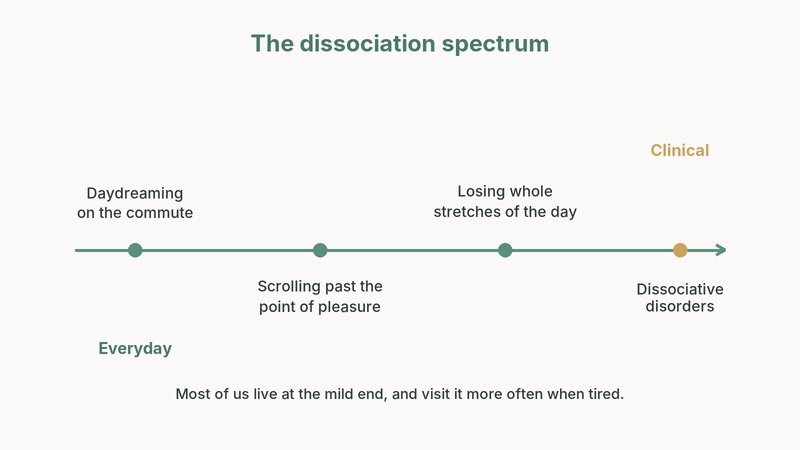
Everyday dissociation is the mind quietly stepping away while the body carries on: a protective habit of checking out under load, not a disorder. It sits at the mild end of a wide spectrum and it is far more common than most people realise. Noticing it is the first act of care.
Let me show you how common this is, why the mind steps away, what it might look like in your own day, and how the coming back begins.
Dissociation is more common than most people think
When people hear the word dissociation, they often picture something dramatic from a film. A person losing hours. A second personality taking over. These portrayals belong to the more extreme end of what is in fact a wide spectrum.
Trauma researcher Bessel van der Kolk, in The Body Keeps the Score, describes dissociation as one of the most intelligent ways the body learns to cope with what feels unbearable. The same mechanism that lets a child get through something terrible also lets a tired adult get through a Wednesday: daydreaming on a long drive, scrolling past the point of pleasure, getting to the bottom of a page and realising none of the words landed.
Why we do it
Dissociation is not a flaw. It is a protection that became habit. Peter Levine, the founder of Somatic Experiencing, frames it in Waking the Tiger as part of an unfinished survival response: the system stepping back when fight or flight are not available. For a child living with something unsafe, this can be life-saving. For an adult running on very little sleep, surrounded by deadlines, or carrying old grief, it is the nervous system doing its quiet best to keep you functional. The cost is that many of us begin to live there without noticing, and wonder later why we feel flat, tired, or distant from the people we love.
What it might look like for you
Therapist Allison Briggs uses the phrase "everyday dissociation" for this quiet, functional version. It is woven into the rhythms of ordinary life. It does not look like crisis. It looks like coping.
You might notice any of the following. None of these on their own is a problem. Taken together, they are worth paying attention to.
- Getting lost in a familiar route and not remembering how you arrived.
- Finishing a work task and realising you cannot recall doing it.
- Zoning out during conversations, then nodding as though you heard.
- Scrolling for an hour that felt like ten minutes.
- Feeling strangely unemotional during moments that usually move you.
- A quiet, fuzzy feeling behind the eyes at the end of a long day.
A familiar version goes like this. Somebody sits down, takes a breath, and realises with a quiet laugh that they cannot quite remember the MRT ride over. The body delivered them to the door and the rest of them is still catching up. We slow down together until the rest arrives.
A softer version of the same thing sometimes happens mid-sentence. The gaze drifts toward the window, the conversation begins to loop, the thread of what was being said gets lost. When the moment is gently named and the pace invited to slow, the room changes. Something arrives that was not there a moment before.
Noticing is the first act of care
The goal is not to never dissociate. The goal is to have a relationship with it. To recognise when it is serving you and when it is taking something from you. Over the next few days, pay attention to the handful of moments each day when you seem to disappear: the commute, the after-dinner scroll, the third coffee. You do not need to judge them. You do not need to stop them. You only need to notice them.
When you are ready to come back, the body is closer than you think. A glance around the room, a slow breath out, a quiet noticing of where your hands are resting. That is enough to begin. If you want the longer practice, I write about it more fully in Finding Your Way Back to Your Body.
Coming back to the platform
Everyday dissociation is not something to fear. It is a sign that your system has been carrying a lot. It tells you where the load is heaviest, and where some care might be well spent.
The next time the MRT doors open and you realise you were somewhere else, let that be the moment you begin to pay attention. Not with shame. With curiosity. The commute still happens. You get to be there for it.
Further reading
- Bessel van der Kolk, psychiatrist and trauma researcher. The Body Keeps the Score: Brain, Mind, and Body in the Healing of Trauma. Viking, 2014.
- Peter Levine, founder of Somatic Experiencing. Waking the Tiger: Healing Trauma. North Atlantic Books, 1997.
- Allison Briggs, psychotherapist. Recognizing Everyday Dissociation: A Survival Strategy Hiding in Plain Sight. Psychotherapy Networker, March/April 2026.
Crisis support and a note on this post
This post is educational and is not a substitute for psychotherapy. If you are in crisis in Singapore, please reach out. Samaritans of Singapore (SOS) is available at 1767. The Institute of Mental Health 24-hour helpline is 6389 2222. In an emergency, call 999.
If any of this resonates and you would like a space to work through it, you are welcome to Book a Consultation or Explore Working Together.