
How to Ground Yourself: A Trauma-Informed Guide

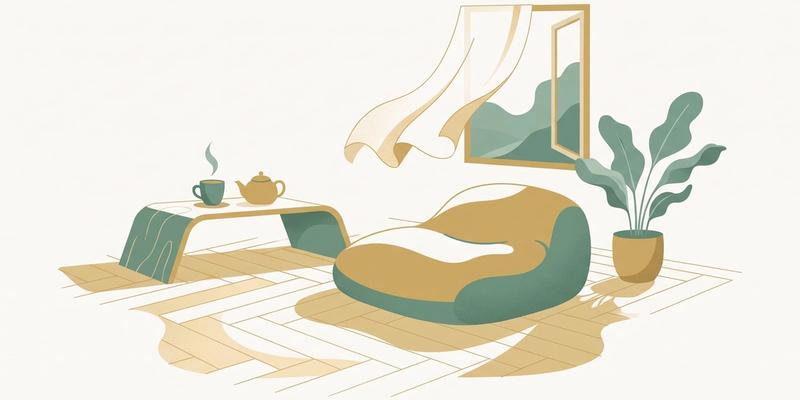
There is a particular quality to the moments when we leave ourselves. Sometimes it is sudden. A loud voice. A phone call. A smell we did not expect. The world drops half a step away from us and we hear it as though from the next room. Sometimes it is slow. We begin the day present in our body, and by lunchtime we are somewhere in our head, and the day goes by without us ever quite arriving.
If you have carried trauma, large or small, old or recent, this leaving will be familiar. You may have learned to leave so early and so well that you rarely noticed you were gone.
I want to sit with what it means to come back. Not as a technique, not as a checklist, but as a slow, lifelong practice of returning to the body that has been waiting for you all along.
To ground yourself, start smaller than the exercises suggest: let your eyes rest on one thing in the room, lengthen one out-breath, notice your fingers, then your toes. Repeated in small doses, this slowly rebuilds the felt sense that the ground is reliable. For trauma, that rebuilding is not a warm-up. It is the work.
The body is the way home
Most of the trauma healing I trust takes the body as its starting point. Bessel van der Kolk, in The Body Keeps the Score, argues that talk alone cannot reach where trauma actually lives.
The mind can describe a childhood clearly while the body continues to brace for a threat that ended decades ago.
Healing asks for both. This matters because many high-functioning adults in Singapore live primarily from the neck up. We think, plan, optimise, strategise, and both our work and our education have rewarded us for exactly that. We can tell you what we feel, intellectually, without feeling it. Healing asks us to come back down. Not in a way that flattens the intelligence of the mind, but enough that the body gets a say again.
Dissociation, up close
Before we talk about coming home, it helps to understand what leaving looks like.
Psychiatrist Frank Anderson, in a recent Psychotherapy Networker conversation with editor Livia Kent, describes dissociation as existing on a wide spectrum. At one end are the extreme presentations that follow severe trauma, where a person may lose time or move between distinct states of self. At the other end are the very ordinary ways most of us slip out of presence when life asks too much: scrolling, daydreaming, spacing out at the end of a long meeting. Many of us live somewhere in the broad middle of that spectrum and do not know it has a name.
For a child whose early world was unsafe, unpredictable, or emotionally absent, dissociation is often the most intelligent thing the small body could do. It kept her functional. Sometimes, literally, alive. The difficulty is that when it continues into adulthood as a default, it quietly takes things from you: the capacity to be moved by a sunset, to feel your partner's hand on your back, to know what you want for dinner. You stay functional, but more and more lightly connected to your own life.
A softer version of this shows up often before it can be named. A gaze drifting mid-sentence, a conversation that begins to loop, the thread of what was just being said quietly going missing. When the moment is named gently and the pace invited to slow, the room changes. Somebody arrives.
Dissociation is not the enemy. It is a part of you that once kept you safe and it deserves respect. Most of us simply reach a point where the cost becomes too high and we want something else.
Why ordinary grounding often is not enough
Many of us have heard of grounding exercises. Feel your feet on the floor. Name five things you can see. Take a deep breath. These are useful. They are also, for people carrying significant trauma, often insufficient. Not because they are wrong, but because they ask the body to do something it cannot yet do.
Trauma researchers Ruth Lanius, Sherain Harricharan, Breanne Kearney, and Benjamin Pandev-Girard, in Sensory Pathways to Healing from Trauma, point to something they call gravitational security: a fundamental, largely unconscious sense of being held by the earth, of having a centre, of feeling in the body that the ground beneath you is reliable. In people with chronic dissociation, that sense is disrupted. Asking such a person to "feel their feet on the floor" is asking the impossible. The floor, to their nervous system, is not yet a place to rest.
Grounding is not a warm-up for the real work. For many people it is the work.
If you have tried grounding exercises and they have not landed, you are not broken. Your nervous system may simply be telling you, very honestly, that the foundation those exercises assume is not yet in place.
The slow building of gravity
So what does it look like to build that foundation?
It looks slower, more ordinary, and less heroic than most people expect.
The starting point is the simplest possible sensations. Not the ones we think we should feel, but the ones that are actually available. Here is the sequence I return to, both for myself and with clients.
First, I look around the room. Not to name five things, but to slowly let my eyes rest on one thing at a time. A corner of the window frame. A plant. The way the light is falling on a particular patch of floor. This tells the visual system that the room is not dangerous, that the perimeter is known, that I am not being watched.
Then I breathe. Not in any special way. Just a little longer on the out-breath than feels natural.
Then I notice my fingers. Not all at once. I might notice the index finger first, then the thumb, then the palm. I let the attention move gently, the way you would move through a dark room looking for a light switch. Without urgency.
And then I notice my toes. They are often the furthest thing from awareness. They tell me something real about how much of me has arrived.
This takes less than two minutes. It sounds almost embarrassingly simple. Over time, repeated in small doses through the day, it begins to rebuild something that is difficult to name. A sense that the body is a place you can be. A sense that the ground is underneath you. A sense that coming back is possible.
Why the room itself matters
Stephen Porges, in The Pocket Guide to the Polyvagal Theory, makes a complementary point. The nervous system is constantly scanning the environment for cues of safety, and only when those cues land does the body shift out of its ready-for-danger setting. Grounding works, when it works, because it slowly tells the system that the danger has passed.
This is sobering and freeing at once. Half of grounding is not what you do. It is what surrounds you while you do it. A room with a closed door. A trusted person nearby. A familiar mug in your hands. The work begins by letting the nervous system register, in its own slow way, that there is no longer something to outrun.
When the thinking self goes quiet, parts begin to speak
If you spend time in this kind of work, eventually the body becomes quiet enough that you begin to hear other parts of yourself. Not in a dramatic way. Not as voices. More like threads of feeling that were always there, just underneath the noise.
Trauma treatment pioneer Janina Fisher, in Healing the Fragmented Selves of Trauma Survivors, describes this as the moment when the survival strategies that kept you functional start to show themselves. A part of you that has been working very hard to stay small. A part that has been rehearsing the worst case. A part that is exhausted. A part that is angry. A part that has been holding the grief of a childhood nobody else acknowledged.
Fisher's approach invites a particular kind of listening. We do not try to fix these parts or get rid of them. We get curious about them, thank them, and let them tell us, in their own time, what they have been carrying.
You do not need to do this alone. In fact, one of the things that distinguishes trauma work from self-improvement is the role of the relationship. The presence of a trusted, attuned therapist is not a nice accessory to the work. It is part of how the nervous system learns that it is safe to come back.
A Singaporean return
It is worth saying out loud that this way of working sits a little sideways to how many of us were raised here. The culture I grew up in taught me to leave the body, to push through tiredness, to eat quickly, to stay productive, to manage feelings by not having them. The kiasu drive that has made Singapore remarkable in many ways has also made it difficult for many of us to sit and notice what our body is telling us.
Coming home to the body is quietly radical in that context. It says that being well is not the same as being productive, that rest is not laziness, and that the slow practice of noticing your fingers might be the most important thing you do that day.
You do not have to travel anywhere to do this. The floor beneath your feet and the breath you are about to take, are enough to begin.
What I would say to someone starting out
If you have read this far, something in you is listening. A few gentle invitations.
Go slowly. The instinct to make this another optimisation project is itself a sign of how much we have been trained to leave ourselves. Do not put it on a spreadsheet. Aim for one honest minute, several times in the day, when you come back.
Stay ordinary. The most powerful practice is often the least spectacular. Noticing your hand on a cup of tea, feeling your back against the chair, hearing the aircon hum: these are not warm-ups. They are the practice.
Notice the urge to leave. When it arrives, it is information. It tells you something has become too much. You do not have to push through. You can pause, name what is happening, and come back at a pace your body can meet.
Ask for company. If the leaving is happening more than you can hold alone, it is a deeply sensible thing to ask for help. Trauma does not heal well in isolation.
You have been away. The body has been waiting. Welcome home.
If this resonates, you can subscribe at the bottom to be notified when new pieces land.
Home is closer than it seems
Healing is not about going somewhere. It is about returning. Find your way back to yourself. Not in one great movement. In the smallest, quietest moments of a Tuesday afternoon. The breath. The fingers. The toes. The floor.
Further reading
- Bessel van der Kolk, psychiatrist and trauma researcher. The Body Keeps the Score: Brain, Mind, and Body in the Healing of Trauma. Viking, 2014.
- Frank Anderson and Livia Kent. The Dissociation Spectrum. Psychotherapy Networker, March/April 2026.
- Ruth A. Lanius, Sherain Harricharan, Breanne E. Kearney, and Benjamin Pandev-Girard, trauma researchers. Sensory Pathways to Healing from Trauma: Harnessing the Brain's Capacity for Change. The Guilford Press, 2025.
- Stephen Porges, behavioural neuroscientist. The Pocket Guide to the Polyvagal Theory: The Transformative Power of Feeling Safe. W. W. Norton, 2017.
- Janina Fisher, clinical psychologist. Healing the Fragmented Selves of Trauma Survivors: Overcoming Internal Self-Alienation. Routledge, 2017.
Crisis support and a note on this post
This post is educational and is not a substitute for psychotherapy. If you are living with the weight of unresolved trauma, please do not try to do this alone. The presence of a trained, attuned therapist is often what makes the work safe and possible.
If you are in crisis in Singapore, please reach out. Samaritans of Singapore (SOS) is available at 1767. The Institute of Mental Health 24-hour helpline is 6389 2222. In an emergency, call 999.
If you would like a steady, unhurried space to begin coming home to yourself, you are welcome to Book a Consultation or Explore Working Together.
Also read
- How to Stop Overthinking: It Is Not a Thinking ProblemOverthinking is rarely a thinking problem. It is often the mind's way of staying away from a feeling. A Singapore therapist's gentler reframe.
- The Autopilot Commute: Recognising Everyday DissociationSpacing out on the MRT is not a character flaw. It is a small form of dissociation, and noticing it is the first step back to yourself.