
What Is IFS Therapy? Where No Part of You Is Bad


Listen to how people talk when they are being honest. "Part of me wants to resign. Another part is already rehearsing how to explain it to the relatives at Chinese New Year." "Part of me knows he loves me. Another part keeps waiting for the door to slam." Nobody teaches us this grammar. We reach for it because it describes something true about how minds actually work.
Internal Family Systems, usually shortened to IFS, is a psychotherapy developed by family therapist Richard Schwartz. It treats the mind as naturally made up of parts, each with its own role and history, and helps them work together under the leadership of a calm core the model calls Self. IFS takes that sentence seriously. I will make the strange-sounding words, parts and Self, plain, show you what a session looks like from the inside, and place IFS next to better-known approaches like CBT and EMDR, ending with the question I think matters more than any single model: not which therapy is best but which is right for you, now.
You already speak in parts
Schwartz kept noticing that his clients described their inner lives the way he described families: distinct members with their own opinions and old grudges. Instead of treating that as loose talk, he started working with each inner voice as if it were somebody worth knowing. The model that grew out of those conversations now has a name for what you already do at the dinner table: the mind is naturally made up of parts.
This is not a disorder and it is not the same thing as dissociative identity disorder, which is a distinct clinical condition. Having parts is ordinary human architecture. The question IFS asks is not whether you have them. It is how well they are getting along.
In his book No Bad Parts, Schwartz describes parts as inner beings with their own histories and their own reasons. Some run your days. Some guard your wounds. And some are the wounds: young places inside that still carry what happened.
The ones that run your days and the ones they protect
IFS observes that parts tend to take up three kinds of roles. There are the proactive ones that manage life so pain never gets triggered: the inner critic that reviews your every sentence, the planner that rehearses tomorrow at midnight, the achiever that learned worth has to be earned and re-earned, and the dutiful child that cannot say no when a parent calls. In a city that treats busyness as virtue, these managers are often praised their whole lives, which is part of why they cannot stop. There are the reactive ones that pull the fire alarm when pain breaks through anyway: the sudden numbness, the doomscrolling at 1am, the third drink, the rage that arrives before you do. And beneath both kinds are the ones being protected: young, tender parts carrying old loads of shame, fear, or grief, kept out of sight because their feelings once felt unsurvivable. Some have carried their load since PSLE year, when worth first seemed to arrive stapled to a result slip.
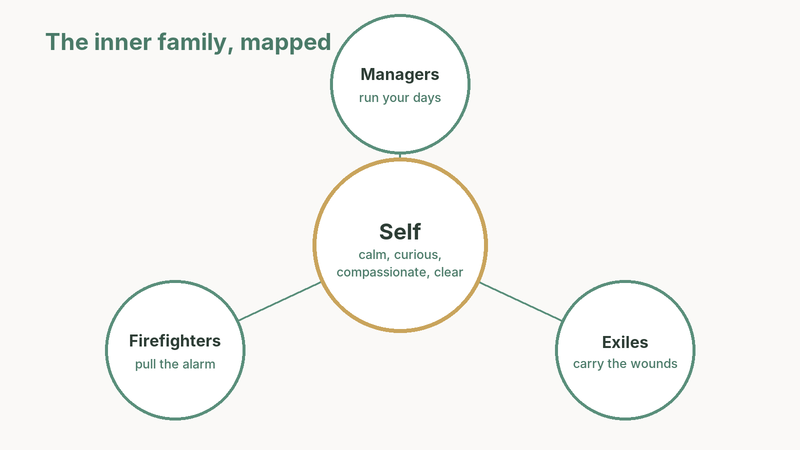
Seen this way, some familiar struggles change shape. The war between pushing through and resting is not indecision; it is two protectors who disagree about how to keep you safe. I have written about that particular tug-of-war in Why You Feel Torn Between Pushing Through and Resting and about the protector most people misread in Your Anger Is Not the Problem.
No bad parts
Here is the heart of the model and the reason its founding book is called what it is called: every part has a positive intent. Not a pleasant effect. An intent.
The inner critic is not your enemy. It is a bodyguard that never learned to clock off.
Ask a critic what it is afraid would happen if it went quiet and you will not hear cruelty. You will hear fear. If I stop, you will get complacent. Then you will fail. Then you will lose face in front of everyone. And I remember how that felt. The criticism is a strategy, learned in a season of life when it may genuinely have been the best available option. IFS calls the extreme beliefs and feelings a part carries its burden. The point of the work is not to delete the part. It is to help the part set the burden down.
If posts like this are useful to you, you can subscribe at the bottom of the page to be notified when new posts are up.
Self: the calm the parts are waiting for
IFS holds that underneath all the parts there is something that is not a part: a core the model calls Self, marked by qualities like calm, curiosity, compassion, and clarity. You have met it. It is the you that shows up when a friend is in trouble at midnight: steady, warm, not panicking, somehow knowing what to say.
The practical skill of IFS is noticing the difference between being flooded by a part and being with it. "I am anxious" is a flooded sentence; the part has the microphone and the whole stage. "A part of me is anxious" sounds like wordplay and it is not. The moment you can say it and mean it, there is somebody doing the noticing and that somebody can turn toward the anxious part with curiosity instead of drowning in it.
You are not the storm. You are the one who can sit with the storm.
What actually happens in a session
An IFS session looks like a conversation, with more curiosity in it than analysis. When something flares, a wave of guilt, a familiar self-attack, we slow down and turn toward it together. How long has this part been doing this job? What is it afraid would happen if it stopped? What does it want you to know? People are routinely moved by what they find. Patterns they have hated for decades finally make sense because the part behind them is finally heard.
The pace matters and it is one of the things I most respect about the model. IFS does not barge past the protectors to get to the tender young parts; it asks permission and it takes no for an answer because a protector that gets overridden has every reason to slam the doors harder afterwards. When the protectors are ready, the deeper work of witnessing what a young part has been carrying, and helping it finally set that burden down, tends to unfold with a gentleness that surprises people.
On evidence: the research base for IFS is young and promising rather than settled. It was listed as an evidence-based practice on a United States national registry in 2015 and early studies, including a small pilot with adult survivors of multiple childhood traumas published in the Journal of Aggression, Maltreatment and Trauma, found meaningful reductions in post-traumatic symptoms and depression. Larger trials are still needed and the IFS Institute says so plainly on its own research page, which I respect. I am IFS Level 1 trained and continuing towards certification. Parts work is one of the two core lenses of how I practise.
IFS next to CBT, EMDR, and body-based work
It helps to see where IFS sits on the map. I have drawn the full map, six approaches side by side, in Types of Trauma Therapy, Explained.
CBT, cognitive behavioural therapy, is the approach most people have heard of. It works with the links between thoughts, feelings, and behaviour: catch the distorted thought, examine the evidence, test a new response, practise between sessions. It is structured, skills-based, and well supported by research. For many people, particularly with anxiety, low mood, and unhelpful habits, it is exactly right. The difference in stance is this: where CBT examines the thought, IFS asks who inside is speaking. A critic that gets debated often argues back. A critic that gets understood often softens.
EMDR, developed by psychologist Francine Shapiro in the late 1980s, is a structured and well-researched trauma therapy that works directly with how distressing memories are stored, using guided eye movements while a memory is briefly held in mind. It is protocol-driven where IFS is relational and for single-incident trauma it can be remarkably efficient.
And then there is the body. Parts do not only speak in words; they speak in a tight jaw, a braced chest, a stomach that drops before a meeting. That is why IFS pairs so naturally with somatic, body-based work, which I have written about in a companion post, What Is Somatic Therapy?. In practice I move between the two constantly: the parts give the body's signals a voice and the body tells me when a part has actually let go rather than merely agreed to.
There is no best therapy
Here is the honest ending and it applies to every approach on this page, including the one I love. Decades of comparative outcome research, summarised by psychotherapy researchers Bruce Wampold and Zac Imel in The Great Psychotherapy Debate, keep finding that no single bona fide model wins for everyone. The fit between you, the person you sit with, and what you are carrying predicts more of the outcome than the brand name of the method.
The question is not which therapy is best. It is what you need, now.
That is why I practise integratively. Someone in crisis may need structure and skills before any deep work. Someone who has talked circles around their pain for years may need the body first. Someone whose inner life is a war zone of shoulds may need parts language before anything else makes sense. The model serves the person, never the other way around.
So, having read all this, one question worth sitting with: which part of you read this post? The one hoping something can finally change, or the one checking whether this too will disappoint? Both are welcome here. What might each of them be waiting to hear?
Common questions, answered quickly
Who developed IFS therapy?
Internal Family Systems was developed by American family therapist Richard Schwartz in the 1980s. He noticed that clients naturally described their inner lives as families of parts and he built a model that works with those parts rather than against them. His book No Bad Parts remains the most accessible introduction.
How long does IFS therapy take?
There is no fixed number of sessions. Some people feel a shift within the first month, simply from relating to their inner critic differently. The deeper work, where a young part finally sets down what it has been carrying, tends to unfold over months because IFS moves at the pace your protectors allow. That pacing is a feature, not a delay.
What can IFS therapy help with?
IFS is used for trauma, anxiety, depression, shame, and inner conflict, including the endless argument between the part that pushes and the part that has had enough. If your anxiety tends to arrive as overthinking or a harsh inner voice, parts language often makes sense of it quickly, which is why I draw on this lens in anxiety-focused work too.
Can I do IFS on my own?
You can begin on your own. Books like No Bad Parts include exercises and simply practising the sentence "a part of me feels anxious" instead of "I am anxious" changes how you relate to your inner life. The deeper unburdening work usually needs a therapist because protective parts tend to relax only inside a relationship they have tested and found steady.
Further reading
- Richard Schwartz, founder of Internal Family Systems. No Bad Parts: Healing Trauma and Restoring Wholeness with the Internal Family Systems Model. Sounds True (2021).
- Hilary Hodgdon and colleagues. Internal Family Systems (IFS) Therapy for Posttraumatic Stress Disorder (PTSD) among Survivors of Multiple Childhood Trauma: A Pilot Effectiveness Study. Journal of Aggression, Maltreatment & Trauma, 31(1) (2021). doi.org/10.1080/10926771.2021.2013375
- IFS Institute. Research. ifs-institute.com/resources/research
- Bruce Wampold and Zac Imel, psychotherapy researchers. The Great Psychotherapy Debate: The Evidence for What Makes Psychotherapy Work, second edition. Routledge (2015).
A note on this post
This post is educational and is not a substitute for psychotherapy. If you are reading about approaches and wondering which one fits what you are carrying, that is a good question and you do not have to answer it alone. A free 20-minute discovery call is a low-pressure place to talk through the different approaches and what would suit you and your circumstances. You are welcome to Book a Consultation or Explore Working Together.
If you are in crisis in Singapore, please reach out. Samaritans of Singapore (SOS) is available at 1767. The Institute of Mental Health 24-hour helpline is 6389 2222. In an emergency, call 999.
Also read
- Anger at a Parent: Why Yours Is Not the ProblemAngry at a parent who keeps hurting your family? The anger is not a failing. It is a signal. A Singapore therapist on the first honest truth. Part 1 of 3.
- Why You Feel Torn Between Pushing Through and RestingWhat if the part of you pushing through and the part asking for rest are both protectors? A Singapore psychotherapist on inner conflict.