
High-Functioning Depression: Signs and What Helps


High-functioning depression describes living with depression while still delivering and still looking fine. It is a description, not a diagnosis. The nearest clinical concept is persistent depressive disorder, a chronic, lower-grade depression that can run for years. The functioning does not cancel the depression. It hides it and the cost builds up quietly.
It often looks like this. The last hour of the workday still goes well. You encourage a colleague and you are warm with a client who needed it. Then the front door closes at home, the bag drops, and the face comes off with the shoes. What is underneath is not sadness exactly but static. The evening is long and there is nothing in it you want to walk towards.
I want to talk about the mask, the signs that hide inside a functioning life, and what genuinely helps, including on days when help feels like one more task.
The mask is the best-made symptom
Something worth saying plainly, from inside the profession: a person who is determined to hide depression can build a mask good enough to fool a professional. Warmth, humour, competence, eye contact, all of it intact. Clinicians are trained to look past performance, and a well-practised mask can still hold. If it can hold in a therapy room, it can certainly hold in a Monday stand-up.
A determined mask can fool a professional. Fooling your colleagues is not proof you are fine.
The people who wear it usually do not experience themselves as hiding. The mask went on years ago, one small concealment at a time, until being fine became a reflex rather than a decision. Many do not lead with sadness at all. Some arrive flat and numb, describing a life with the sound turned off. Some arrive with chronic tiredness as the only complaint, sometimes after a medical check-up that found nothing, because exhaustion was the one symptom that could be identified.
A lot of times the tiredness is not discovered until something stops. Sometimes you do not know your arms are sore until you let go of the weight.
This is the version of depression that is not talked about enough. Nothing has visibly collapsed. Everything has just quietly dimmed.
What it is, and what it is not
High-functioning depression is not a diagnosis you will find in a manual. What clinicians recognise underneath it is often persistent depressive disorder: a depression that is chronic rather than acute, long enough and low enough that a person can mistake it for their personality. Others meet the full picture of a major depressive episode while continuing to work through it. The label matters less than the correction it carries: functioning is a measure of what you are managing, not of how unwell you are.
Functioning does not mean mild.
The frame I work with in the room is plainer than any of those labels. Depression is a suppression of life energy, a lid that comes down over the part of you that wants things. A lot of people hear that and assume the lid is the enemy. Usually it came down for a reason. Somewhere along the way it stopped feeling safe to carry that much life energy, and something in you contained it. That is worth knowing before you go to war with your own flatness, because a lid that came down to protect you does not lift by being shamed.
It is also not rare, and not a private failing. Singapore's National Youth Mental Health Study found that 14.9 percent of people aged 15 to 35 reported severe or extremely severe symptoms of depression, with the highest rates, one in five, among 20 to 24 year olds: the exact years of first jobs and proving yourself. Most of those people did not stop showing up. That is rather the point.
If your version of this question is "am I depressed or just tired", the honest answer is that the border runs through rest: tiredness responds to it, depression does not, and burnout sits in between, tethered to work in a way depression is not. I have written about that border in the burnout piece.
The signs that hide inside a functioning life
None of these is a diagnosis. Together, they are a pattern worth taking seriously:
- Work gets most of your days and the weekend disappears into sleep and scrolling that never leaves you rested
- Interests thin out one by one, not dramatically, just quietly not worth the effort any more
- Feelings arrive quiet: not so much sadness as numbness, or simply nothing at all
- Tiredness becomes chronic and unexplained, and sleep stops repairing it
- The inner commentary turns prosecutorial: what do you have to be depressed about, others have it far worse
- Tears or hopelessness surprise you at strange, small moments, out of proportion to anything that just happened
The numbness in particular deserves some compassion before we fight it. Our body is very smart. If it had not disconnected you somewhere along the way, you would have been in real trouble. And when fatigue is shut out for long enough, it does not get better; it just goes numb. Numbing is not weakness in any sense that matters. It kept you functioning while something underneath went unattended. None of that means it should stay. It means the solution is not to attack it.
If the numbness feels older than this season of life, less like something new and more like something that was always there, that thread has its own post: childhood emotional neglect.
The spiral that tightens quietly
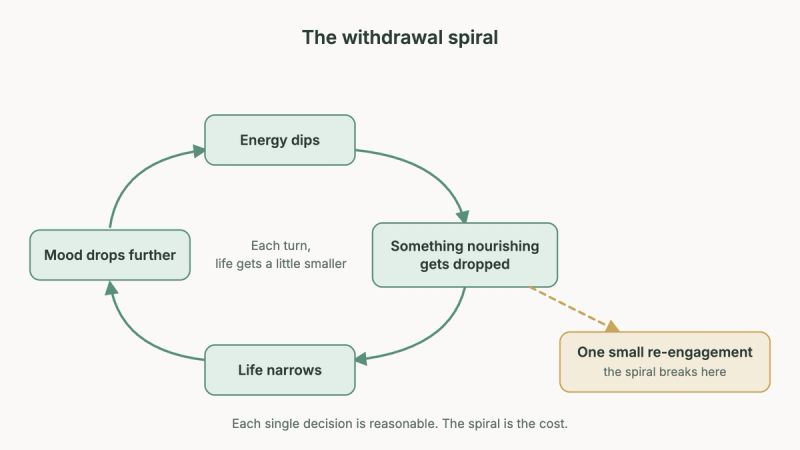
Depression narrows life by logic, not laziness. Your energy drops, so something has to be dropped. The work almost never goes. What goes is the thing that fed you: the class, the friend, the walk, the instrument. Life gets a little smaller, so less comes back in. Less colour, less contact, fewer reasons to believe the effort is worth it. Mood drops again, energy follows, and the next thing goes. Each single decision is reasonable. The spiral is the cost.
The functioning mind then does what functioning minds do: it analyses. Why am I like this, what is wrong with me, when did I become this person. Psychologist Susan Nolen-Hoeksema spent a career showing that this rumination is not insight; going over and over a low mood reliably deepens and prolongs it, while doing almost anything else with the attention loosens its grip. Every time we narrate something, we reinforce it. The analysis feels like working on the problem but it is the problem, wearing a work outfit.
What genuinely helps
Everything below is small on purpose. Depression taxes every action, so anything that helps has to be priced for a depleted system.
Tell one person
Not an announcement, just one honest confession to one safe person: things have been grey for a while and I do not really know why. The mask's real cost is that it seals you in isolation. Breaking that seal, once, changes the economics of everything that follows, and it is often the single hardest step on this list.
Take the critic off the bench
The voice saying you have no right to feel this way is not a fair judge; it is part of the illness, and prosecuting yourself for being depressed is depression's favourite pastime. It also has a logic worth understanding. The inner critic is a survival instinct: the more depressed a person becomes, the smaller they make themselves, and staying small is an old strategy for not being noticed. Psychologist Kristin Neff's research on self-compassion keeps finding the same thing: treating yourself with the kindness you would offer a friend is associated with lower depression, not lower standards. Softening that voice is clinical work, not indulgence.
This is usually where someone tells me that nothing helps, that they have tried the walk and the early night and the weekend away and none of it fills them up. It is empty not because the tap is not on. It is empty because the cup is inverted. Turn the cup up first.
Go through the body, gently
A depressed system is often a shut-down system, and shutdown responds better to gentle activation than to analysis. A ten-minute walk in the morning without the phone. One meal eaten as a meal. None of this cures depression; all of it gives the nervous system small pieces of evidence that the world still has something in it.
Re-engage before you feel like it
This one is backwards, though it carries some of the strongest evidence in the field. The approach is called behavioural activation: you go back to the small things that used to feed you before you feel like it, not after. Psychologist Neil Jacobson tested it in trials. Psychologist Sona Dimidjian and colleagues tested it again later. It held up against full cognitive therapy and against antidepressant medication.
Motivation follows action far more often than it leads it.
Start almost insultingly small. Message the friend. Water the one plant. Play the instrument badly for five minutes. You are not trying to feel better tonight; you are interrupting the spiral at its weakest point.
A lot of my work is pointing at exactly this. The most healing part of therapy does not happen in the therapy room. It happens outside it, during the week, in the small re-entries nobody is there to witness.
And when the load needs more than self-help, that is what psychotherapy is for. If hopelessness is deepening, or thoughts of not wanting to be here have started arriving, please treat that as a signal for prompt support from a professional, your GP, or the crisis lines below, not as a stronger version of tiredness.
If posts like this are useful to you, you can subscribe at the bottom of the page to be notified when new posts are up.
One more thing that comes up often in this city. When people tell me they feel no joy, I am often not sure whether the joy is genuinely absent or whether it has stopped being recognisable. Joy is not always euphoria. Sometimes it arrives quietly, mixed in with grief, and it feels flat. It was still joy. If you are scanning for the big feeling as proof that you are getting better, you can walk straight past the small ones that are actually the recovery.
There is an anxious cousin of this pattern, the person whose functioning is driven rather than drained. I have written about high-functioning anxiety as this post's companion; some people will recognise themselves in both, sometimes in the same week.
The front door will close again tonight and the face will come off with the shoes. One question worth sitting with, gently: if the mask came off in front of one person this month, who would you want that person to be?
Common questions, answered quickly
Is high-functioning depression a real diagnosis?
No. It is a descriptive term. The nearest clinical concept is persistent depressive disorder, a chronic, lower-grade depression lasting two years or more; some people described as high-functioning actually meet criteria for major depression while continuing to work. A proper assessment with a professional is what settles the question.
Can you be depressed without feeling sad?
Yes and it is common. The opposite of happy is not sad; the opposite of happy is not-happy. Depression often arrives as numbness, irritability, flatness, or chronic unexplained tiredness rather than visible sadness. Some people only recognise it when interests quietly disappear or tears surprise them at nothing. Absence of sadness is not absence of depression.
Am I depressed or just tired?
Watch what rest does. Tiredness responds to sleep and time off. Burnout eases partially when work stops because it is tethered to work. Depression follows you into the things you love and does not lift with rest. If the flatness has gone everywhere and stopped responding to recovery, take it seriously.
How do I help someone who seems fine but might not be?
Ask twice. The first answer is usually the mask. Something like: you seem tired lately and I am actually asking, how are you doing? Then listen without fixing. You are not trying to diagnose anyone; you are making it safe for one honest sentence, which is often the beginning of everything.
Further reading
- Susan Nolen-Hoeksema, Blair Wisco and Sonja Lyubomirsky, psychologists. Rethinking Rumination. Perspectives on Psychological Science, 3(5) (2008). journals.sagepub.com
- Sona Dimidjian and colleagues, psychologists. Randomized Trial of Behavioral Activation, Cognitive Therapy, and Antidepressant Medication in the Acute Treatment of Adults with Major Depression. Journal of Consulting and Clinical Psychology, 74(4) (2006).
- Kristin Neff, psychologist and self-compassion researcher. Self-Compassion: Theory, Method, Research, and Intervention. Annual Review of Psychology, 74 (2023). self-compassion.org
- Mythily Subramaniam, psychiatrist and researcher at the Institute of Mental Health, and colleagues. Examining Psychological Distress Among Youth in Singapore: Insights from the National Youth Mental Health Study. Asian Journal of Psychiatry, 105 (2025). sciencedirect.com
Crisis support and a note on this post
This post is educational and is not a substitute for psychotherapy. If the dimming described here is familiar and you would like steady support with what is underneath it, you are welcome to Book a Consultation or Explore Working Together.
If you are in crisis in Singapore, please reach out now. Samaritans of Singapore (SOS) is available at 1767. The Institute of Mental Health 24-hour helpline is 6389 2222. In an emergency, call 999.
Also read
- What Is High-Functioning Anxiety? The Cost of Coping WellYou are excelling at work and exhausted inside. A Singapore psychotherapist on high-functioning anxiety: the signs, the hidden cost and what helps.
- What Is Childhood Emotional Neglect? The ACE No One NamesNothing bad happened, yet something feels missing. A Singapore psychotherapist on childhood emotional neglect, the ACE that hides in plain sight.