
Burnout Recovery Stages: How Long It Takes, What Helps


Burnout recovery moves through four stages:
- Stopping and meaning it
- Restoring the body's rhythm
- Repairing the conditions that caused the burnout
- Returning to work on different terms
The body tends to recover in weeks; the conditions take months because the timeline depends more on which mismatch burnt you out than how well you rest. In one Swedish study of 232 people with stress-related exhaustion, most improvement came within the first three months, though a third still had symptoms at 18 months.
A pattern I observed over and over again goes like this. Someone finally stops. They sleep, they walk. Food starts to taste like something again. Then after around three weeks, complacency kicks in: they feel good. The energy is back, the mind is quick again and the backlog is right there waiting. So they sprint again and the crash that follows this sprint is usually harder than the initial burnout because this time it comes with a new thought attached: even rest did not work on me.
The truth is, rest did not fail you but it was interrupted at the very first stage for your body.
So here are the things I wish more people are aware of: why recovery has stages at all, what each stage actually involves, the false positive where most relapses happen, what sets your timeline and a word for those whose burnout came from caring for other people.
Why recovery has stages at all
If burnout were only tiredness, rest would suffice for the job and rest reliably does not. That is because burnout is a compound injury.
Burnout is not just exhaustion. It is exhaustion plus loss of agency, meaning and support.
Each part of that repairs differently, and at a different speed. Sleep can rebuild energy while your sense of agency is still flat on the floor. You can feel physically restored and still go cold at the thought of opening your laptop. A recovery plan that only addresses the exhaustion treats one injury out of several, which is why so many people return from a proper break and slide straight back into burnout within a month or two.
These are stages rather than steps: they overlap and loop and nobody moves through them tidily. But the order matters because each stage builds the foundation for the next one.
Stage one: stopping and meaning it
Stopping means naming what is happening, out loud, at least to yourself: this is burnout, not a bad quarter and it is not going to lift by itself.
Two things are needed in this stage. The first is subtraction: removing something visible off your plate now rather than at the end of the project. It can be renegotiating a deadline or releasing a standing meeting. Subtraction is how your nervous system learns that the stopping is real.
The second is harder. Many people cannot start recovery because they are waiting for permission, for the collapse or the diagnosis that would finally make rest legitimate.
If that is you, let this be said plainly: you do not need to earn recovery by breaking down first. Most high performers carry a part that says push on and a part that wants to rest. By the time burnout arrives, the rest part has nearly lost its voice, which does not mean it is gone. That tug of war has its own post because it is the real gate to stage one.
Stage two: giving the body back its rhythm
This is the stage most people picture when they imagine recovery. Proceeding with this stage involves getting back proper sleep hygiene and routine, incorporating movements and sunlight to reset the body and allow it to stop bracing for a threat that has technically ended.
The research adds one non-obvious requirement for this stage to work. Work psychologist Sabine Sonnentag and colleagues have shown that recovery depends more on how much you psychologically detach from work than on the amount of time off taken: the hours when work is genuinely not present in your mind are the hours that repair you. It is something I say often in the therapy room: your body has not knocked off from work just because you have physically knocked off. A fortnight of leave with the work phone within reach can deliver less recovery than ordinary evenings that are honestly, fully off work. Detachment, not duration, is the active ingredient.
Done properly, this stage returns energy within weeks, which is exactly where recovery becomes dangerous.
The false positive, where most relapses happen
Energy comes back before capacity does; that is the whole trap.
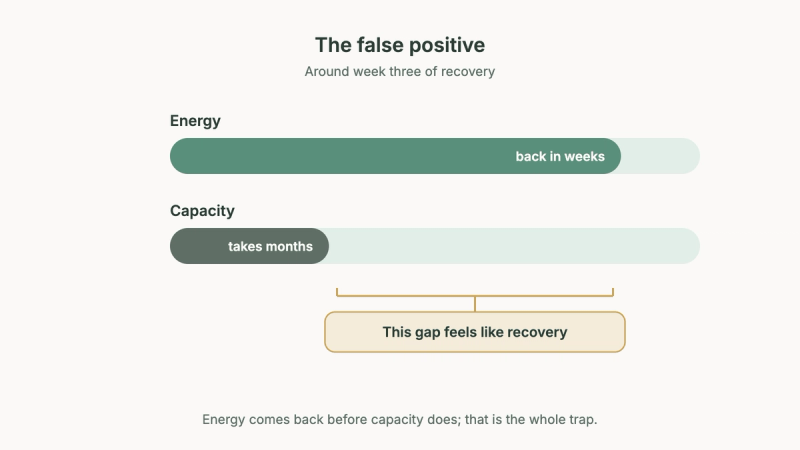
The first good weeks are real and they are evidence of stage two working, nothing more. Even though your sleep has been good, your conditions have not changed and your boundaries have not been challenged; the part of you that overcommits is still there, ready to create the relapse.
Feeling better is the start of the repair work, not proof that it is finished.
If you take one practical rule from this post: when the good week arrives, hold your load flat for another month. Use the returning energy for stage three, not for clearing the backlog.
Stage three: repairing what burnt you out
This is the stage where the holiday cannot help and the one that decides whether the recovery lasts. Burnout researchers Christina Maslach and Michael Leiter locate burnout in the mismatch between person and job across six areas: workload, control, reward, community, fairness and values. Stage three is mismatch repair: name yours honestly, then work the ones that can be worked.
Some of that can be worked with boundaries and negotiation: workload subtracted in a way that can hold up through the next busy season, autonomy carved back in small territories, recognition asked for rather than silently resented. If you return rested to an unchanged and impossible system, the recovery will be fragile, however well you rested; self-care cannot carry what is actually a systemic load. Some mismatches are yours to influence and some belong to the organisation, not to your nervous system. Mapping which is which is exactly what the free stress management worksheet walks you through and it is worth doing on paper rather than in your head.
This stage is measured in months and it is where support matters: a steady outside eye on which repairs are working and on what the deeper patterns are doing underneath.
Stage four: returning on different terms
The last stage is quieter and easily overlooked: rebuilding a relationship with work. Understanding that your worth is not the same thing as your output. People who skip it recover on paper and stay hollow in reality: the energy is restored and the meaning is still missing.
This is where the deeper questions lie. How did productivity become your identity? What does rest evoke when you actually take it? Guilt, unfamiliarity, the fear of falling behind?
Tricia Hersey, founder of The Nap Ministry, frames rest as the recovery of personhood from a culture that measures humans by output. The Singapore version of that culture is familiar: worth measured in output since primary school and the fear of being the one who slowed down. Rest is not the opposite of responsibility here; it is part of sustainable responsibility. Learning to embody that belief rather than just a thought is the real work of stage four.
Practically, this stage ends with relapse-proofing: your early-warning signs identified and written down and one person in your life who has the permission to call you out if you are repeating your pattern.
If you burnt out from caring
A word for the helpers: the caregivers, the teachers, the nurses and, yes, the therapists, whose burnout came not from spreadsheets but from carrying people. The advice to care less is useless to you and it misdiagnoses the problem. The problem is rarely caring too much; it is becoming responsible for what you cannot control, with an empathy dial stuck at maximum.
Recovery for helpers is learning to adjust empathy. Staying warm without being flooded, clear without being cold. It sounds like a betrayal of the work but it is the opposite.
Boundaries are not the withdrawal of care. They are the structure that allows care to continue.
What actually sets the timeline
The honest answer to "how long does burnout recovery take" is: which mismatch burnt you out? A pure overload problem can ease within weeks once real subtraction happens. Control and recognition problems may take months to negotiate as it involves other people. A mismatch in values takes the longest and the solution may be exiting altogether and that takes planning to execute.
If posts like this are useful to you, you can subscribe at the bottom of the page to be notified when new posts are up.
The good week is coming and when it arrives it will make a persuasive case for you to sprint. Let that be information instead: proof that the body is healing and a signal that the real repair work can begin now.
Common questions, answered quickly
What are the stages of burnout recovery?
Four, roughly: stopping and naming it, restoring the body's rhythm, repairing the mismatches that caused the burnout (workload, control, reward, community, fairness, values) and returning to work on terms where worth is not output. They overlap rather than proceed tidily and the middle carries a trap: energy returns before capacity does.
How long does burnout recovery take?
It depends on which mismatch burnt you out. Overload can ease within weeks of genuine subtraction; mismatches involving other people move at the speed of negotiation; a values mismatch is slowest because its repair may be an exit. In one Swedish study following 232 people with stress-related exhaustion, most improvement came in the first three months, though a third still had symptoms at 18 months.
Why do I keep relapsing into burnout?
It is usually one of two reasons and often both. You sprinted at the false positive, spending the first returned energy on the backlog instead of on repair. Or you recovered yourself but returned to an unchanged system and no amount of personal recovery outlasts an impossible workload. Fragile recoveries are almost always missing stage three.
Can I recover from burnout without quitting my job?
Often, yes. Overload, control and recognition mismatches can frequently be repaired in place through subtraction and negotiation. The honest exception is a deep values mismatch: if the job quietly requires you to act against what matters to you, recovery may eventually point at the door and knowing that early is kinder than finding out after two more depleted years.
Further reading
- Christina Maslach and Michael P. Leiter, burnout researchers. The Burnout Challenge: Managing People's Relationships with Their Jobs. Harvard University Press (2022).
- Sabine Sonnentag and Charlotte Fritz, work and organisational psychologists. Recovery from Job Stress: The Stressor-Detachment Model as an Integrative Framework. Journal of Organizational Behavior, 36 (2015). doi.org/10.1002/job.1924
- Kristina Glise, Gunnar Ahlborg Jr and Ingibjörg H. Jonsdottir, stress medicine researchers. Course of Mental Symptoms in Patients with Stress-Related Exhaustion: Does Sex or Age Make a Difference?. BMC Psychiatry, 12 (2012). doi.org/10.1186/1471-244X-12-18
- Tricia Hersey, founder of The Nap Ministry. Rest Is Resistance: A Manifesto. Little, Brown Spark (2022).
- Psychotherapy Networker, Sept/Oct 2025 issue. The Burnout Epidemic: How Therapists Can Revolutionize Rest.
Crisis support and a note on this post
This post is educational and is not a substitute for psychotherapy. If you are somewhere on this map and would like steady support for the stages ahead, you are welcome to Book a Consultation or Explore Working Together.
If you are in crisis in Singapore, please reach out. Samaritans of Singapore (SOS) is available at 1767. The Institute of Mental Health 24-hour helpline is 6389 2222. In an emergency, call 999.
Also read
- Burnout Symptoms: What Rest Cannot FixYou rested and you are still exhausted. A Singapore psychotherapist on burnout symptoms, the six mismatches behind them, and what actually repairs it.
- Why You Feel Torn Between Pushing Through and RestingWhat if the part of you pushing through and the part asking for rest are both protectors? A Singapore psychotherapist on inner conflict.