
How to Stop Overthinking: It Is Not a Thinking Problem

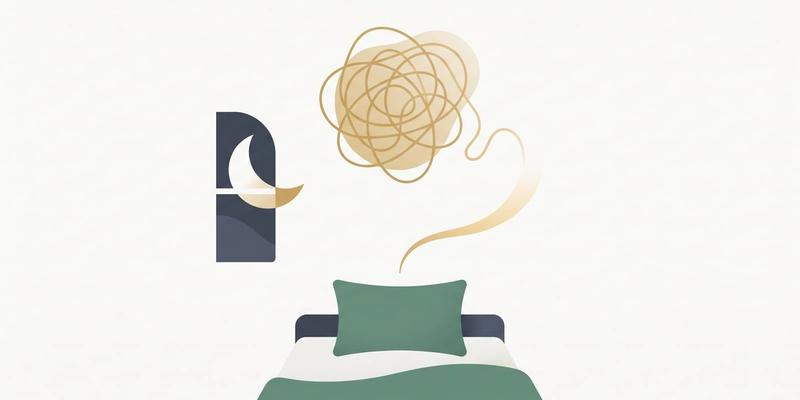
It is 3am. The ceiling is a familiar shade of grey. Your mind is rehearsing tomorrow's conversation again, the third run-through tonight. You tell yourself you are preparing. Somewhere beneath the rehearsal, there is a smaller, quieter ache you have not looked at. And the thinking, you notice, gets louder whenever the ache tries to surface.
Most people treat overthinking like a thinking problem. The assumed fix is more thinking. More analysis, more lists, more planning. If I can just work it out one more time, the rehearsal goes, then I will be able to rest.
The rest rarely comes. The loops get longer.
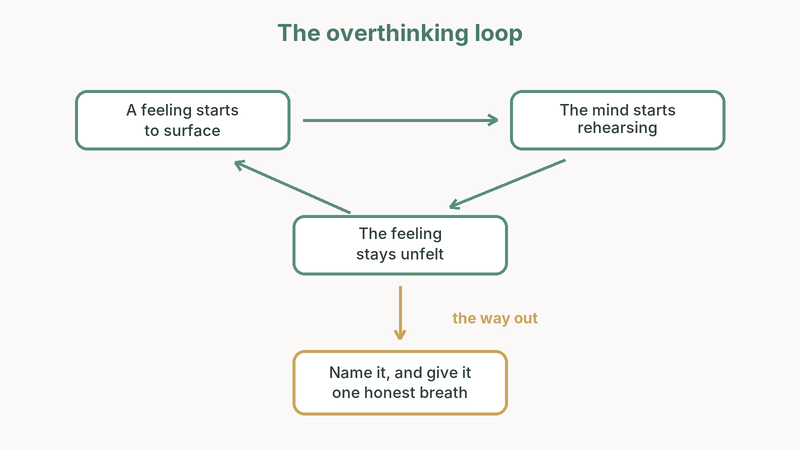
Overthinking is rarely a thinking problem. Rumination is usually the mind's way of staying ahead of a feeling it does not want to touch, so the way out is not sharper analysis. It is noticing what the body is holding, naming the feeling underneath, and letting it have one honest breath.
That is the reframe I return to often in the therapy room and I want to walk through it slowly with you.
Overthinking is usually about a feeling, not a problem
The thing the mind is "solving" is almost never the real load. In my work as a psychotherapist, one of the most consistent patterns I notice is that rumination is a way of managing uncomfortable feelings. The mind stays busy so that you do not have to feel.
Think of a hamster wheel. The running feels purposeful. The effort is real. The wheel is not taking you anywhere. The motion is the point, because stopping would mean sitting with whatever is underneath.
What is underneath varies. Guilt about a conversation that did not land the way you wanted. Fear of being found wanting. Shame that you are not further along than you think you should be. Anger you have not given yourself permission to feel. The specifics differ. The pattern is the same. The thinking rises whenever the feeling gets close.
In Cognitive Therapy of Anxiety Disorders, cognitive researchers David Clark and Aaron Beck describe rumination as a cognitive avoidance strategy. It looks like engagement with the problem. It functions as a way of staying away from the feeling the problem is attached to. You have been using the right tool on the wrong problem.
There is a particular shape this takes for many readers in Singapore. The kiasu reflex rewards anticipation of every angle, every objection, every variable, and over time the mind learns to outpace the body. The strategy that won you school stops working when adulthood asks you to grieve, to wait, to feel. You cannot think your way out of dread. The wheel still turns. The 3am ceiling is still grey.
If overthinking has been the way you have always coped, the suggestion that the work lies somewhere other than thinking can feel destabilising. It is also, in practice, where the loosening begins.
The question worth changing
The shift that tends to unlock this pattern is quiet.
From: How do I stop overthinking? To: What am I trying not to feel?
Notice that the second question does not come with pressure. It is not a demand to feel the thing. It is an invitation to let it be named.
Cognitive behaviour therapist Judith Beck, in Cognitive Behavior Therapy: Basics and Beyond, has noted that mindfulness is most useful precisely for clients caught in rumination, worry, obsessive thinking, and the avoidance of internal experiences. The treatment effect is not in the thinking itself. It is in the slow building of a relationship with whatever the rumination has been working hard to keep out of view.
The first feeling that arrives, when you let it, is rarely as large as the defence built around it. Often it is something fairly ordinary. Tiredness. Disappointment. A small, steady sadness. A flicker of anger that has been waiting to be acknowledged. When it is named, the wheel slows. Not because you have solved the feeling, but because the mind no longer needs to run to keep it at arm's length.
The body tells you first
The feeling underneath almost always arrives in the body before the mind catches up.
Trauma researcher Ruth Lanius and her colleagues, in Sensory Pathways to Healing from Trauma, describe interoception as the body's inner sensing channel, the quiet way it tells us what it is experiencing. A tight jaw. A held breath. A knot just below the sternum. Many spirals begin with one of these small signals, which the mind then leaps in to outrun.
If you can catch the body a second before the thinking takes over, you have a different door to try.
What to try when the loops begin
The next time you notice the mind beginning to rehearse, before the third or fourth loop builds momentum, try this. Instead of asking "what am I thinking about?", ask:
What is happening in my body right now?
Look for the smallest thing. A tightness behind the sternum, a held breath, a knot in the jaw. You are not trying to fix it. You are trying to notice it is there, and let whatever feeling is attached to it have a name.
Often, naming is enough to begin. The wheel does not stop immediately. It slows. In the slowing, the feeling gets the space it was asking for in the first place.
The first feeling that arrives is rarely as large as the defence built around it.
If this resonates, you can subscribe at the bottom to be notified when new pieces land.
When the feeling underneath is not small
Sometimes the feeling beneath the rehearsal is not a small one. Sometimes the overthinking is carrying grief, old fear, a wound that has been quietly managed for years. A single moment of noticing is not going to clear that. It is not meant to.
What a moment of noticing can do is show you where the load has been sitting. That is useful information. It tells you what is asking for care. From there, the work is slower, and it is usually best done in a space where you are not carrying it alone.
It is 3am, again. The ceiling is still grey. The mind has begun its rehearsal. This time, before the third run-through, you let the breath out. You feel for the first thing beneath the thinking. A tightness in the chest. A smaller, quieter word than you expected. You name it. You stay with it for one breath. The wheel slows.
Further reading
- David A. Clark and Aaron T. Beck, cognitive therapy researchers. Cognitive Therapy of Anxiety Disorders: Science and Practice. The Guilford Press, 2009.
- Judith S. Beck, cognitive behaviour therapist. Cognitive Behavior Therapy: Basics and Beyond, 3rd edition. The Guilford Press, 2020.
- Ruth A. Lanius and colleagues, trauma researchers. Sensory Pathways to Healing from Trauma: Harnessing the Brain's Capacity for Change. The Guilford Press, 2025.
Crisis support and a note on this post
This post is educational and is not a substitute for psychotherapy. If you are in crisis in Singapore, please reach out. Samaritans of Singapore (SOS) is available at 1767. The Institute of Mental Health 24-hour helpline is 6389 2222. In an emergency, call 999.
If you are wondering how much of the overthinking is anxiety, the free two-minute anxiety check-in gives you a clearer picture in seven questions; a check-in, not a diagnosis.
If any of this resonates and you would like a space to work through it, you are welcome to Book a Consultation or Explore Working Together.
Also read
- Putting Down the Apologies That Were Never YoursIf you keep saying sorry for things that were never yours to carry, that is not politeness. It is a pattern with a name.
- Anger at a Parent: Why Yours Is Not the ProblemAngry at a parent who keeps hurting your family? The anger is not a failing. It is a signal. A Singapore therapist on the first honest truth. Part 1 of 3.